Ghaznavids In India
Early Muslim rulers of
Sind and Punjab.
Mahmud
Ghazni ( 998-1030 AD) Mahmud of Ghazni a
Turkish slave who vowed to undertake every year an expedition against the
idolators of India, was the first to carry the banner of Islam into the heart
of India and to tread the path in which
so many followed him . Mahmud began raiding the Indian territories on a regular
basis between 1001 and 1021 A.D,and said to have raided 17 times and
destroyed hundreds of Hindu temples and plundered dozens of Indian
cities. The plunder taken was enormous : 548 pounds of pure gold from Mathura
and 1260 elephants , 53000 human captives ,excluding diamonds ,etc .In January
1025 he plundered the famous temple of Somnath in Gujarath . He made no
attempts to rule Indian territory except for the Punjab which was the gateway
to India .He established Ghaznavid
province in Punjab, Sindh & Lahore
consistent with his Afghan territories in 1028 A.D.

He issued a remarkable silver Dirham from Mahmudpur (Lahore) has a unique bilingual legend with the Kalima in Arabic on the obverse and its translation in Sanskrit on the reverse as “ avyaktameka muhammada avatar nripati mahamuda ” (The Invisible is One , Muhammad is the manifestation, Muhammad the King.) Marginal legend in Sanskrit as : avyaktiya name ayam tankam hato muhamuda samvati 418 (In the Name of Invisible , This tanka was struck at Mahmudpur 418 ” Most Islamic coins of India simply carry legends in Persian .But this early Islamic coin reflects a more compromising attitude ,in that the local population is approached through the presence of Sanskrit on the coin
Yamin ud daula Bahram-1118-52
He came to the throne executing Arsalan and then
he finished his other brothers also. He lost Ghazni to the Ghur ruler and so
had to shift capital to Lahore
- Turks -
Muhammad
Ghori (1192 -1206 AD) / Muhammad Bin Same
In
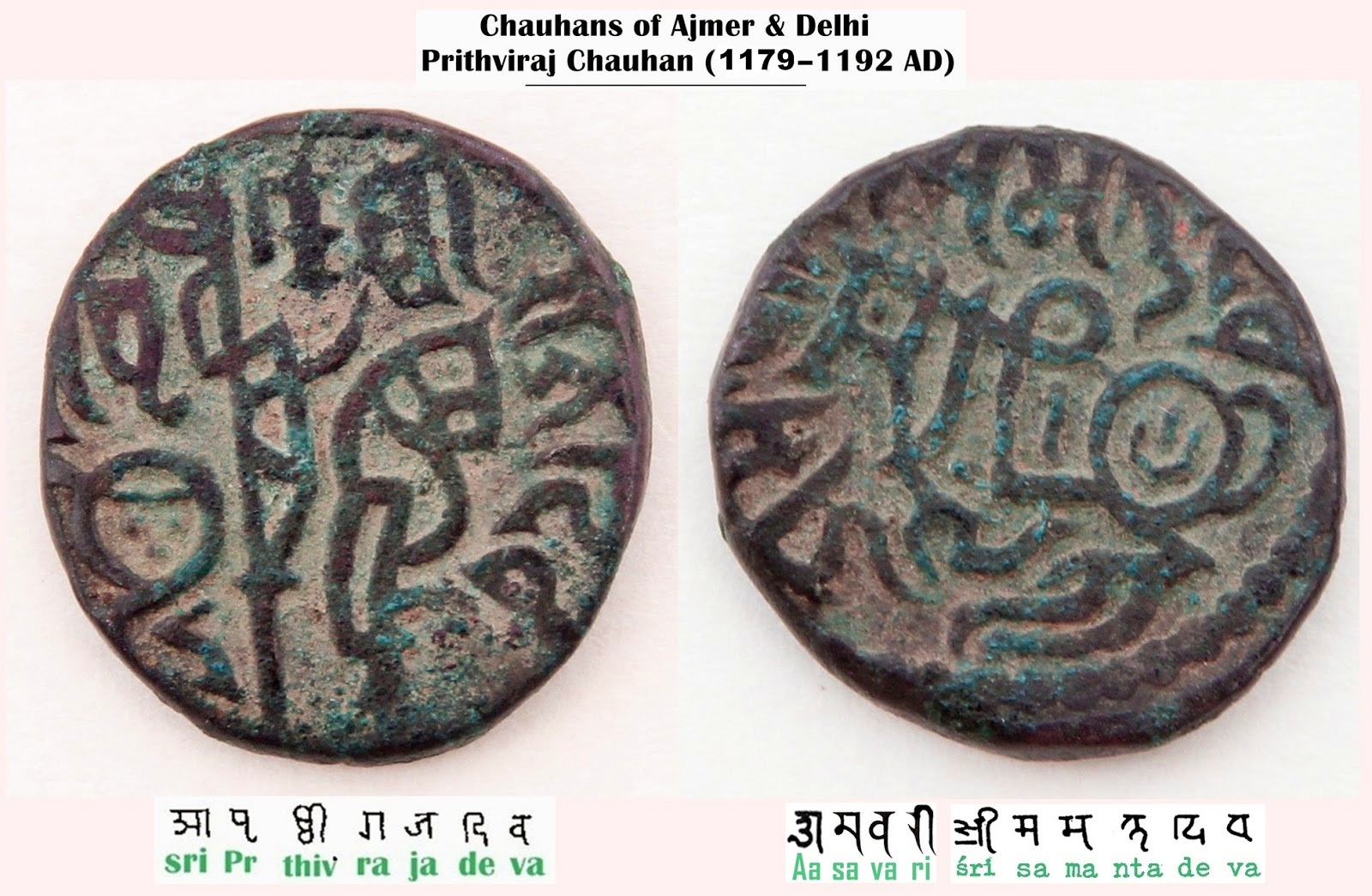
1192 AD Muhammad Ghori invaded India with large army and defeated Prithviraj
Chauhan of Rajput Dynasty . this victory of Taraori gave Muhammad northern India almost to the gates of Delhi , Muhammad
appointed Qutb-ud- Din Aibak as his viceroy
of his new conquests with a discretion to extend them .At the end of 1192 AD
Aibak captured Delhi which was destined to be the capital of Islamic power in
India . The dynasty of Muhammad Ghori is known as the slave dynasty ..
Mahmud’s successors adopted
the ‘Bull-and-Horseman’ type modifying it into a ‘Bull-and-legend’ type with
the name of the ruler in Kufic Arabic script.
The Ghaznavids were deposed by Ghorids in Ghazni and finally evicted
from Lahore by the Ghorid brothers, Ghiyath-uddin and Muizz-uddin in 1186 A.D.
Muizzuddin or Muhammad Ghori (known as Muhammad bin Sam on his coins) succeeded
in laying down the foundations of the Dehli Sultanate by defeating Prithviraj
Chauhan at the Battle of Tarrain in 1192 A.D.
Muhammad bin Sam copied the ‘Bull-and-Horseman’ coin called Dehliwalas
with either side devoted to Arabic inscriptions and issued them in billon and
copper. Muhammad also
copied the Lakshmi type gold coin when he captured Kashi from Jayachandra, the
famed rival of Prithviraj Chauhan, with the Nagari legend ‘Sri Mahamada bini
saame’! In Bengal, his general Bakhthiyar Khilji initiated a new gold prototype
with the obverse image of a charging Turkish horseman with a mace and the
Nagari legend ‘Gaud Vijaye’ and a reverse Arabic inscription with Muhammad’s
titles
Five
different families followed the slave at Delhi
and all of them are collectively known as Sultans of Delhi .


These are scarce Bull and horseman Jitals issued by
Mu'izz ad-din Muhammad, (Muhammad Ghori ) who ruled Budaon subsequently, between 1195 and 1206 AD
Taj ud din Yildiz-1212-14 Taj ud din Yildiz became the ruler of Ghazna following the death of Muhammad bin Sam in 1206. When he lost his Kingdom he captured Lahore from Nasir ud din Qubacha. He claimed Delhi also when Iltutmash was ruling Delhi. He issued coins from Lahore between 1212 and 1214. He was defeated by Iltutmash and executed around 1216.
Iltutmash-1210-35 Qutb-ud-din Aibak died in 1206 in a Polo accident in his capital Lahore. Aram Shah acceded to the throne in Lahore in 1211 assisted by some nobles. When Iltutmish claimed the throne in Delhi, Aram Shah marched towards Delhi but was slain in battle at Bagh-i-Jud. In 1215-1216, Yildiz moved towards Punjab and captured Lahore from Qubacha and laid claim to the throne of Delhi. ltutmish defeated Yildiz at Tarain. By 1220, Jalal ud din Mingburnu fled to the Punjab and captured Lahore and much of the Punjab. Iltutmash marched towards Lahore. Mingburnu retreated from Lahore and moved towards Sind and inflicted heavy defeat on Qabacha. He plundered Sindh and northern Gujarat and returned to Persia in 1224. Iltutmash captured Sind and Multan defeating Qubacha who committed suicide drowning in Indus river after his defeat. He ruled as a persistent invader of surrounding kingdoms until his death in 1235.
Jalalat al-Din Radiyya (Raziyya) (1236–1240 AD)
Razia Sultana who succeeded her father Shams-ud-din Iltutmish to the Sultanate of Delhi in 1236 AD. Iltutmish became the first sultan to appoint a woman as his successor when he designated his daughter Razia as his heir apparent. Razia was the first and last female ruler of Delhi Sultanate (reigning from 1236 to 1240 AD).




%2BBull%2BType%2B%2C%2BCopper%2BJital%2B-3.1%2BGrams%2BLahore%3B%2Bmint%2Binferred.jpg)


.jpg)


.jpg)


